

The Four Cs of Lab Grown Diamonds: Cut, Colour, Clarity & Carat Explained
If you've spent more than five minutes researching diamonds, you've already encountered the 4Cs. Cut. Colour. Clarity. Carat. Four criteria that, taken together, determine what a diamond looks like, how it performs under light, and what it's worth. The system was developed by the Gemological Institute of America — GIA — back in the 1940s and 50s, and it remains the global standard today.
Here's what most people don't realise: these four criteria apply to lab grown diamonds in exactly the same way they apply to mined diamonds. Not approximately. Not "sort of." Identically. A lab grown diamond is chemically, physically, and optically the same as a mined diamond — it's just grown in a controlled environment rather than extracted from the earth. So when you're grading a lab grown diamond, you're using the same D-to-Z colour scale, the same FL-to-I3 clarity scale, the same cut grade system. GIA, IGI, and SGL all certify lab grown stones using the same methodology they use for mined stones.
At Blu Diamonds, every solitaire comes with an IGI certificate that documents all four Cs in full. Understanding that certificate — really understanding it — is what separates a confident purchase from an anxious one. So let's go through each C properly.
Cut — The One C You Should Never Compromise On
Of all four Cs, cut is the one that matters most. It's also the most misunderstood. And it's the only one that's entirely man-made — colour, clarity, and carat are natural properties of the stone. Cut is what a craftsperson does with that stone.
What Cut Actually Means
Cut does not mean shape. Round brilliant, oval, cushion, pear, emerald — those are shapes (technically called "fancy shapes" when they're anything other than round). Cut refers to something more fundamental: how well the diamond's facets are proportioned, aligned, and polished to interact with light.
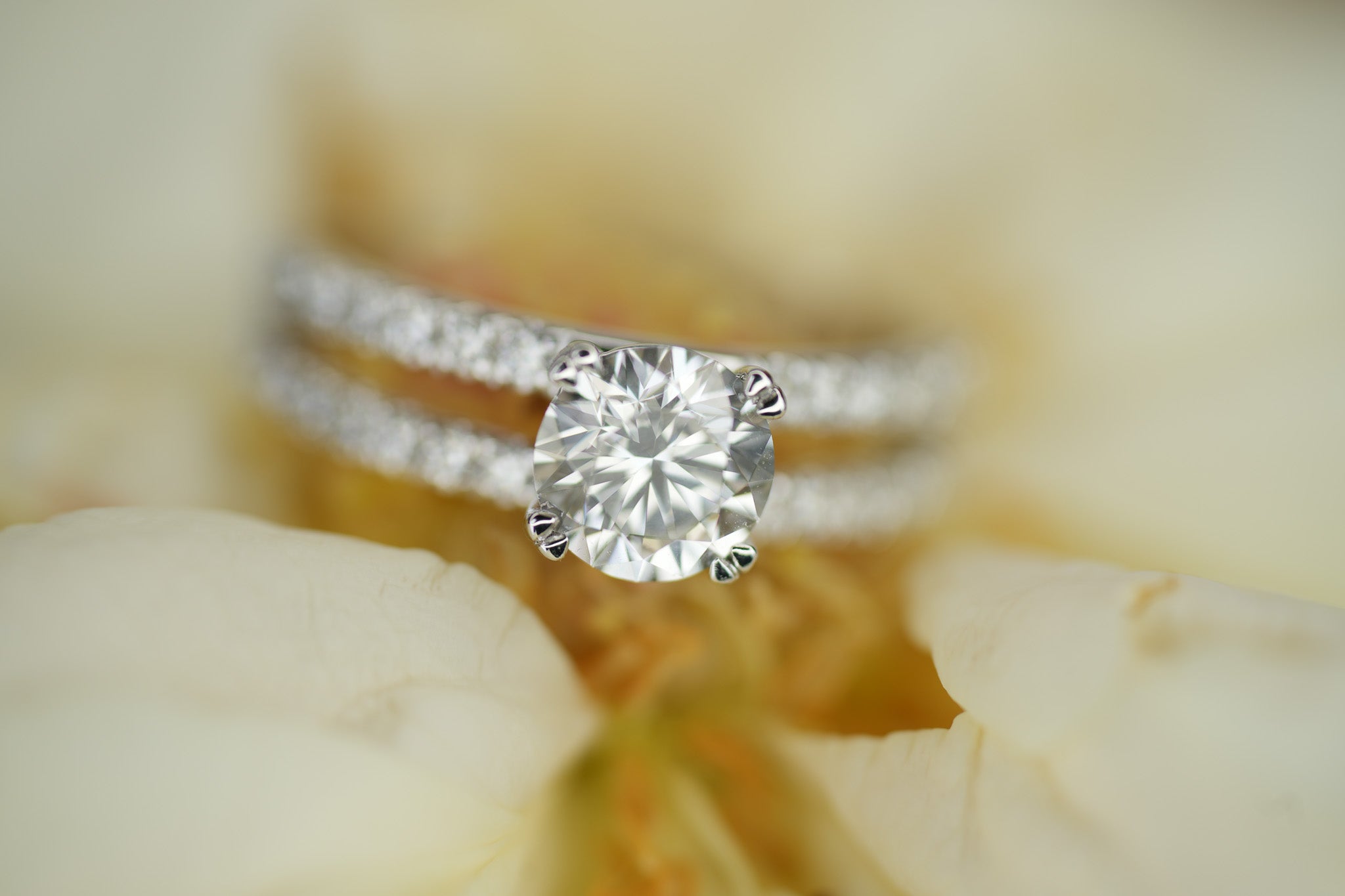
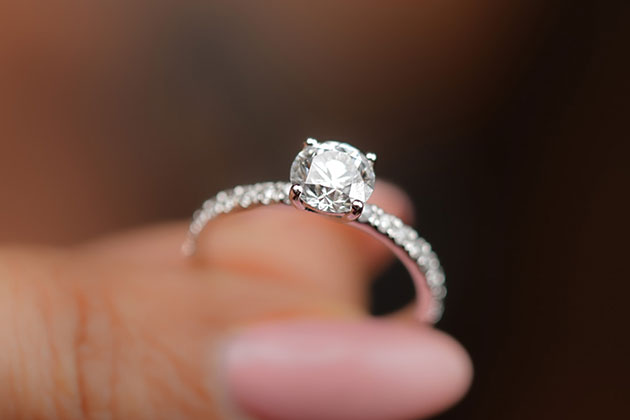
A diamond cutter working with a round brilliant is trying to achieve a precise mathematical relationship between the table (the flat top), the crown (the upper facets), the girdle (the widest point), and the pavilion (the lower facets). If those proportions are off — if the pavilion is too deep, or the table too wide — light enters the stone and leaks out through the sides or bottom instead of bouncing back to your eye. The diamond looks dull. Lifeless. You've essentially paid for weight you can't see.
Get the proportions right, and the same stone transforms. Light enters, bounces internally, and exits back through the top in a brilliant display that's hard to take your eyes off.
The Cut Grade Scale
For round brilliant diamonds, GIA and IGI grade cut on a five-point scale:
- Excellent (EX) — Maximum light performance. The top grade. This is where you want to be.
- Very Good (VG) — Excellent light return with very minor deviations from ideal proportions. Often indistinguishable from Excellent to the naked eye.
- Good (G) — Good light performance, but some light leakage is present. Visible drop in brilliance compared to the top two grades.
- Fair — Noticeable dullness. Not recommended.
- Poor — Significant light loss. Avoid entirely.
Cut grades apply formally to round brilliants. Fancy shapes don't receive an official cut grade on most certificates — which is why buying a well-cut oval or cushion requires more expertise, and why working with a knowledgeable jeweller matters.
How Cut Affects What You See
When jewellers talk about a diamond's visual performance, they use three terms:
- Brilliance — The white light that returns to your eye. The overall brightness of the stone.
- Fire — The dispersion of light into spectral colours — the rainbow flashes you see when a diamond catches a beam of light.
- Scintillation — The pattern of sparkle you see when the stone, the light source, or the observer moves.

All three are directly determined by cut quality. A poorly cut diamond can have a great colour grade and a flawless clarity grade, and it will still look dead next to a well-cut stone with lower grades in the other Cs. This is not an exaggeration — it's something you see immediately when you compare stones side by side.
Our Recommendation on Cut
Never go below Very Good. Excellent is the ideal. If you're working with a tighter budget, sacrifice on carat or clarity before you sacrifice on cut — a smaller, well-cut diamond will always outperform a larger, poorly-cut one.
Colour — Understanding the D-to-Z Scale

For white diamonds — the classic choice — the industry measures colour by how absent it is. The less colour, the higher the grade.
The Colour Grades Explained
- D, E, F — Colourless. The top tier. Truly colourless stones. The difference between D and F is detectable only by a trained grader looking at the stone face-down — face-up in a ring, most people cannot tell them apart.
- G, H, I, J — Near Colourless. Excellent stones with the faintest trace of warmth, essentially invisible to the naked eye. This is where the best value typically lives.
- K, L, M — Faint Colour. A slight yellow tint becomes visible to most observers.
- N through Z — Light to Very Light Colour. Increasing yellow or brown tint. Not typical for solitaire engagement rings.
How Metal Choice Affects Colour Perception
Yellow Gold is warm and rich. Setting a G or H colour diamond in Yellow Gold means the metal's warmth visually counteracts any slight tint in the stone, making it appear whiter by contrast. You can go a step lower on the colour scale and still achieve a beautiful, bright-looking ring.
White Gold is cool and neutral. That backdrop makes colour in a diamond more visible. If you're setting in White Gold, a higher colour grade — F, G, or H — will look noticeably better.
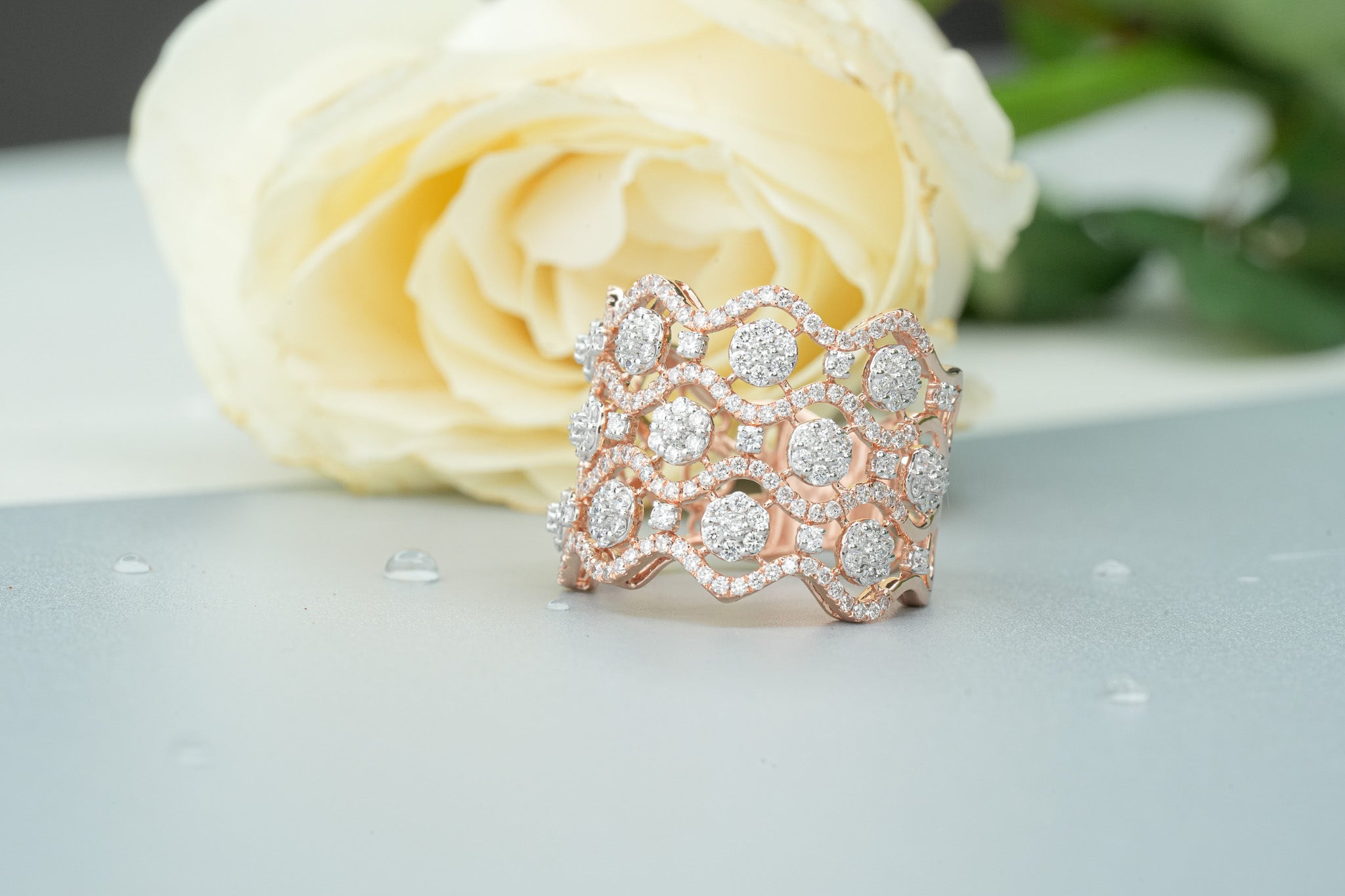
Rose Gold sits between the two. Its warm, rosy tone flatters near-colourless stones beautifully, and the combination of Rose Gold with a G-H diamond has become one of the most elegant pairings in modern jewellery.
Our Recommendation for Lab Grown Diamonds
H colour or better offers excellent value. The premium between H and D in a lab grown stone is more moderate than in mined diamonds — so stepping up to F or G is reasonable if the budget allows. Lab grown diamonds can also be produced in vivid fancy colours — pink, blue, yellow — that are extraordinarily rare in nature. If you want a pink diamond without paying the price of a mined fancy pink, lab grown makes it entirely attainable.
Clarity — What Inclusions Actually Are
Every diamond — mined or lab grown — forms under extreme conditions. That process almost always leaves traces: tiny crystals, feathers, clouds, needles. These internal characteristics are called inclusions. External surface irregularities are called blemishes. Together, they determine clarity grade.
The Clarity Scale
- FL — Flawless. No inclusions or blemishes visible under 10x magnification. Extremely rare.
- IF — Internally Flawless. No inclusions, possibly minor surface blemishes under 10x.
- VVS1 and VVS2 — Inclusions so small they're difficult even for a trained grader to find under magnification. Completely invisible to the naked eye.
- VS1 and VS2 — Minor inclusions visible under 10x magnification, but invisible to the naked eye. Excellent for everyday wear.
- SI1 and SI2 — Inclusions visible under 10x, sometimes visible to the naked eye with effort. Many SI1 stones are "eye-clean."
- I1, I2, I3 — Inclusions visible to the naked eye. Not recommended for engagement rings.
Eye-Clean vs. Technically Flawless
Most people can't see the difference between a VS2 and a VVS1 without a loupe. What matters in a worn ring is whether inclusions are visible to the naked eye — what the trade calls "eye-clean." For most stones, that threshold is around VS2 or SI1. Paying a significant premium for FL or IF clarity in a lab grown diamond is almost never the right financial decision.
The exception: step-cut diamonds — emerald cut or Asscher cut. These cuts have large, open facets that act like windows into the stone. Inclusions are far more visible in step cuts than in brilliant cuts, so clarity matters more here.
Our Recommendation

For brilliant-cut lab grown diamonds: VS1 or VS2 is the sweet spot — eye-clean, beautiful, and significantly more affordable than VVS territory. For step cuts, go VS1 or higher. Avoid I1 and below for any piece worn daily.

Carat — Size vs. Weight (They're Not the Same Thing)
Carat is the most talked-about of the four Cs, and the most misunderstood. People say "two-carat diamond" when they mean a large diamond. But carat is a unit of weight, not size. One carat equals 0.2 grams.
What a Carat Actually Is
A well-cut one-carat round brilliant measures approximately 6.4–6.5mm in diameter. A poorly-cut one-carat stone might measure only 6.0mm — same weight, but smaller face-up — because more weight is hidden below the girdle in a deep pavilion. This is another reason cut matters: a well-cut stone uses its weight efficiently.
The "Magic Numbers" and How to Shop Around Them
Diamond pricing jumps at certain psychological benchmarks: 0.50ct, 1.00ct, 1.50ct, and 2.00ct. A 0.95ct diamond and a 1.00ct are visually near-identical — the difference is roughly 0.3mm in diameter, which no one will notice on a hand. But the 1.00ct costs meaningfully more per carat. Shopping just below these magic numbers is one of the smartest moves a diamond buyer can make.
Why Lab Grown Makes Carat Go Further
Lab grown diamonds are typically 70–80% more affordable than mined equivalents. The buyer who could previously afford a 0.70ct mined diamond can now buy a 1.50ct lab grown diamond with the same budget — and both are real diamonds with identical properties. This isn't a compromise. It's an arbitrage.
How the 4Cs Work Together — Prioritising Your Budget
The professional consensus — and our recommendation — is this priority order: Cut > Colour > Clarity > Carat.
Cut first, always. Colour second — H or better for most settings. Clarity third — VS2 or SI1 eye-clean for brilliant cuts. Carat last — use the magic number trick to maximise size without paying the benchmark premium.
A practical example: a 1.10ct, Excellent cut, H colour, VS2 clarity lab grown diamond will look more spectacular than a 1.50ct, Good cut, J colour, SI2 stone — and likely cost less. The combination of the four Cs is everything.
Reading Your IGI Certificate
Every Blu Diamonds solitaire comes with an IGI certificate. Here's what the key sections mean:
- Report Number — A unique identifier. Verify the certificate at igi.org.
- Shape and Cutting Style — The stone's shape and faceting style.
- Measurements — Physical dimensions in millimetres confirming symmetry and proportions.
- Carat Weight — Listed to two decimal places.
- Colour Grade — The D-Z letter grade.
- Clarity Grade — The FL-to-I3 grade.
- Cut Grade — For round brilliants: overall cut plus separate Polish and Symmetry grades.
- Fluorescence — Whether the diamond fluoresces under UV light. Faint to Medium is generally neutral.
- Comments — Including the notation "Laboratory Grown" confirming origin.
Keep this certificate. It's the permanent record of what you bought — essential for insurance, resizing, and future verification.
Frequently Asked Questions
Do the 4Cs apply differently to lab grown diamonds versus mined diamonds?
No. The 4Cs system applies identically to both. Lab grown diamonds are graded using the same scales, the same equipment, and the same trained gemologists. Your IGI certificate for a lab grown diamond is structured and interpreted exactly like one for a mined stone.
Is a higher carat always better?
Not necessarily. A larger stone with poor cut will look worse than a smaller, beautifully-cut one. Focus on cut first, and let carat be what's left after you've secured quality in the other Cs.
What's the minimum clarity grade you'd recommend for a daily-wear solitaire?
VS2 for brilliant cuts (round, oval, cushion, pear). SI1 is acceptable if the stone is confirmed eye-clean. For step cuts (emerald, Asscher), VS1 as the minimum — the open facet structure makes inclusions far more visible.
Why does the IGI certificate say "Laboratory Grown" — does that affect the quality?
It reflects the origin, not the quality. Lab grown diamonds are priced lower than mined equivalents — which is precisely why they offer such value. The diamond itself has identical properties. The "Laboratory Grown" notation is a factual descriptor of how the stone was created. The 4Cs grades on that same certificate are what tell you about quality.
Shop Lab Grown Diamond Jewellery: Rings | Earrings | Pendants | Bracelets | Engagement Rings | Tennis Bracelets
Read more
5 Diamond Jewelry Styles Every Woman Should Have for New Year’s Celebrations
As the clock strikes midnight on New Year’s Eve, all eyes will be on the sparkle you bring to the celebration. Blu Diamonds.
Read more
Lab-Grown Diamonds: A Girl’s New Best Friend
For decades, the phrase “Diamonds are a girl’s best friend” has been synonymous with luxury, love, and timeless beauty. Blu Diamonds.
Read more