

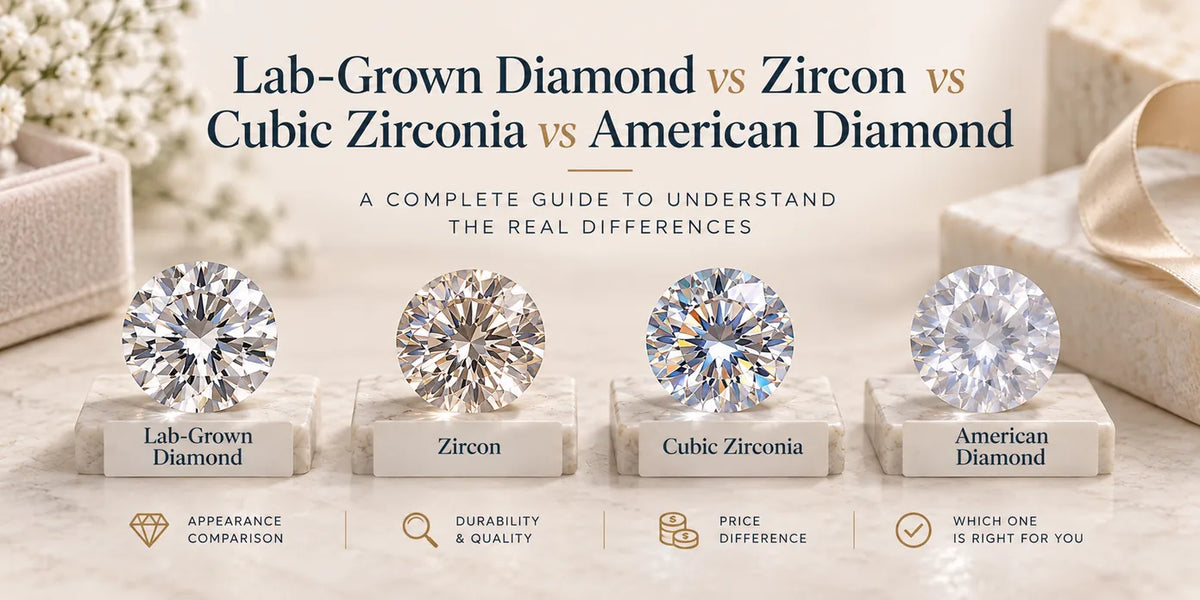
Lab-Grown Diamond vs Zircon vs Cubic Zirconia vs American Diamond: The Complete Guide
When shopping for jewellery, terms such as lab-grown diamond, zircon, cubic zirconia and American diamond can easily become confusing. They may look similar when set in a jewellery piece, but they are different materials with different chemical compositions, hardness levels, origins and buying considerations.
Understanding the difference matters because choosing a diamond alternative is not the same as choosing a diamond. If you are looking for a genuine diamond, a lab-grown diamond belongs in a different category from zircon and cubic zirconia.
This guide explains the lab grown diamond vs zircon, lab grown diamond vs cubic zirconia, and lab grown diamond vs American diamond comparisons in simple terms, so you can choose the right stone for your jewellery.
1. What Is a Lab-Grown Diamond?
A lab-grown diamond is a real diamond created in a controlled laboratory environment rather than formed naturally inside the Earth.
Lab-grown diamonds are produced mainly using two technologies: Chemical Vapor Deposition (CVD) and High Pressure High Temperature (HPHT). These processes create diamond crystals with essentially the same chemical composition and crystal structure as natural diamonds.
Diamond is made primarily of carbon arranged in a cubic crystal structure. This is why a lab-grown diamond is fundamentally different from a diamond simulant such as cubic zirconia. GIA specifically distinguishes laboratory-grown diamonds from simulants because lab-grown diamonds have the essential chemical, physical and optical characteristics of diamond.
Like natural diamonds, lab-grown diamonds can be evaluated using the 4Cs: cut, colour, clarity and carat weight. They can also be identified and documented by specialist gemological laboratories.
2. What Is Zircon?
Zircon is a natural gemstone and should not be confused with cubic zirconia.
Its chemical composition is zirconium silicate (ZrSiO₂). Natural zircon occurs in several colours, including blue, red, yellow, orange, brown and green. Colourless zircon can also resemble a diamond when properly cut.
Zircon has high brilliance and noticeable dispersion, which produces colourful flashes of light. It also has strong double refraction, meaning light passing through the gemstone can split into two images.
On the Mohs hardness scale, zircon generally ranges from 6 to 7.5. That makes it suitable for jewellery, but it requires more care than diamond, particularly when exposed to rough wear or hard impacts.
3. What Is Cubic Zirconia?
Cubic zirconia, commonly called CZ, is a synthetic material made to resemble diamond.
Unlike natural zircon, cubic zirconia is not zirconium silicate. It is based on zirconium dioxide (ZrO₂) and is manufactured under controlled conditions to produce a clear crystalline material suitable for jewellery.
CZ is classified as a diamond simulant. A simulant imitates the appearance of another gemstone without having the same chemical composition. GIA distinguishes cubic zirconia and other simulants from laboratory-grown diamonds because their chemical and physical properties are different from diamond.
Cubic zirconia became popular because it can offer a bright, diamond-like appearance at a much lower material cost. Its colourless appearance makes it common in:
- Fashion rings
- Earrings
- Pendants
- Costume jewellery
- Occasion jewellery
CZ can look very attractive, particularly when it has a good cut and is kept clean. However, cubic zirconia is not a diamond.
4. What Is an American Diamond?
The term American diamond causes perhaps the most confusion in the Indian jewellery market.
An American diamond is generally a market or trade term used for cubic zirconia (CZ) in Indian jewellery. It does not refer to a separate mineral called "American diamond."
Therefore, when comparing American diamond vs cubic zirconia, the two terms often refer to the same underlying stone.
If a product is described as American diamond, check the product specifications to confirm the actual stone material before buying.
5. Lab-Grown Diamond vs Zircon
The biggest difference between a lab-grown diamond and zircon is what the stones actually are. A lab-grown diamond consists primarily of carbon in the diamond crystal structure. Zircon is a natural mineral composed of zirconium silicate. Their chemical compositions and crystal structures are therefore fundamentally different.
Lab-Grown Diamond vs Zircon: Key Differences
| Feature | Lab-Grown Diamond | Zircon |
|---|---|---|
| Composition | Carbon | Zirconium silicate (ZrSiO₂) |
| Origin | Created in a laboratory | Natural gemstone |
| Appearance | Diamond-like brilliance and fire | High brilliance with strong rainbow flashes |
| Hardness | 10 on Mohs scale | 6–7.5 on Mohs scale |
| Durability | Highly resistant to scratching | More susceptible to scratching and impact |
| Price | Generally higher than simulants | Varies by colour, quality and origin |
| Certification | Diamond grading reports can be issued | Gemstone identification reports may be available |
| Typical use | Engagement rings, wedding jewellery, fine jewellery | Rings, earrings, gemstone jewellery |
The hardness difference is particularly relevant for rings. Diamond ranks 10 on the Mohs scale, while zircon ranges from 6 to 7.5. However, hardness measures resistance to scratching; it does not mean a stone cannot chip or break.
For buyers who want a genuine diamond, zircon is not an equivalent substitute. For buyers who specifically want a natural coloured gemstone with strong brilliance, zircon can be an interesting choice.
6. Lab-Grown Diamond vs Cubic Zirconia
The lab grown diamond vs cubic zirconia comparison is more straightforward. A lab-grown diamond is diamond. Cubic zirconia is a diamond simulant. Both can be colourless and sparkly, but their chemistry and physical properties are different. GIA specifically identifies cubic zirconia as an imitation or simulant rather than a laboratory-grown diamond.
Key Differences
Composition: Lab-grown diamonds are carbon crystals. CZ is zirconium dioxide.
Origin: Both are manufactured, but for different purposes. Lab-grown diamonds are grown as diamond crystals, while CZ is produced as a diamond-looking simulant.
Hardness: Diamond is significantly harder than CZ, making lab-grown diamond particularly suitable for jewellery intended for regular wear.
Certification: Lab-grown diamonds can receive diamond grading documentation from recognised gemological laboratories. CZ is not graded as a diamond.
Price: CZ is generally positioned as a low-cost diamond alternative, while lab-grown diamonds are priced as actual diamonds.
7. Lab-Grown Diamond vs American Diamond
The lab grown diamond vs American diamond comparison is essentially a comparison between a genuine diamond and a CZ-based diamond simulant. American diamond is generally used in India to describe cubic zirconia jewellery.
Lab-grown diamond: Real diamond material, laboratory-grown.
American diamond: Generally CZ, a diamond simulant.
If your priority is an engagement ring or another piece where you specifically want a genuine diamond, the distinction is significant. American diamond jewellery can make sense when the main goal is an affordable diamond-like appearance. Lab-grown diamonds make more sense when the material itself matters and you want the physical characteristics associated with diamond.
American Diamond vs Cubic Zirconia
In common Indian jewellery usage, American diamond and cubic zirconia often refer to the same stone material. "American diamond" is a market-facing term, while cubic zirconia is the material name. Always check the product description because jewellery sellers can use terminology differently.
8. Which Is Best for Your Jewellery?
There is no single best material for every buyer. The right choice depends on whether you prioritise genuine diamond material, natural gemstone character, everyday practicality or a lower jewellery budget.
For Engagement Rings & Wedding Jewellery
Choose a lab-grown diamond if you want a genuine diamond with diamond-level hardness and recognised diamond grading. These pieces are frequently worn, so hardness and long-term wear considerations matter. For coloured gemstone designs, natural zircon can also work where its colour and distinctive optical character suit the design.
For Daily Wear
Lab-grown diamond is the stronger choice when the jewellery will experience frequent wear, particularly for rings, thanks to its Mohs hardness of 10. GIA recommends avoiding rough wear and hard impacts with zircon, as it is less hard and can be brittle.
For Fashion Jewellery & Budget-Conscious Purchases
American diamond/CZ is a practical option when the priority is a diamond-like appearance at a lower stone cost — ideal for statement earrings, necklaces and occasion pieces. You are paying primarily for the jewellery design, setting, metal and craftsmanship rather than a genuine diamond.
Quick Reference
| Your Priority | Recommended Choice |
|---|---|
| Genuine diamond | Lab-grown diamond |
| Engagement ring / wedding jewellery | Lab-grown diamond |
| Natural coloured gemstone | Zircon |
| Diamond-like fashion jewellery | American diamond / CZ |
| Lower-cost jewellery | Cubic zirconia |
| Maximum scratch resistance | Lab-grown diamond |
The most important step is to read the stone description carefully. "Diamond look," "American diamond," "CZ," "zircon" and "lab-grown diamond" do not mean the same thing.
9. Frequently Asked Questions
Is zircon the same as cubic zirconia?
No. Zircon is a natural gemstone with the chemical formula ZrSiO₂. Cubic zirconia is a synthetic diamond simulant based on zirconium dioxide. Despite the similar names, they are different materials.
Is American diamond the same as cubic zirconia?
In Indian jewellery terminology, American diamond commonly refers to cubic zirconia. However, always check the product specification because terminology can vary between sellers.
Is a lab-grown diamond a real diamond?
Yes. Lab-grown diamonds are actual diamonds created using laboratory processes such as CVD or HPHT. They have essentially the same chemical composition, crystal structure and key physical and optical characteristics as natural diamonds.
Which is harder: zircon or cubic zirconia?
Both are softer than diamond, but their hardness differs by material and specimen. Natural zircon generally measures 6–7.5 on the Mohs scale. CZ is a different material and should not be confused with zircon.
Is cubic zirconia a fake diamond?
Cubic zirconia is best described as a diamond simulant, rather than a diamond. It is a manufactured material designed to resemble diamond in appearance but does not have diamond's chemical composition.
Which is better for an engagement ring: lab-grown diamond or zircon?
For buyers who specifically want a genuine diamond, a lab-grown diamond is the more appropriate choice. It is actual diamond material and has substantially greater hardness than zircon. Zircon can still be a beautiful gemstone choice if its natural character and colour are the priority.
How can I make sure I am buying a lab-grown diamond?
Look for clear disclosure that the stone is laboratory-grown and request appropriate diamond documentation from a recognised gemological laboratory. Professional laboratories use specialised testing to distinguish laboratory-grown diamonds from natural diamonds and simulants.
Final Thoughts
The biggest mistake when comparing these stones is treating them as different versions of the same material. They are not.
If you want a genuine diamond for an engagement ring, wedding jewellery or fine jewellery, explore lab-grown diamond rings and compare them using cut, colour, clarity and carat. If your priority is a natural gemstone with distinctive colour and brilliance, zircon may be worth considering. If you simply want an attractive diamond-like appearance at a lower stone cost, cubic zirconia or American diamond jewellery can be suitable.
The best choice is the one that matches what you actually want from the jewellery. Explore our collections at bludiamonds.com.
You May Also Like
Read more
2 Carat Lab-Grown Diamond Ring Price in India: What to Expect
A practical 2026 price breakdown for 2-carat lab-grown diamond rings in India — loose stone vs finished ring pricing, what drives the cost, and how to buy smart.
Read more
7 Signs You're Buying a High-Quality Lab-Grown Diamond
Learn the seven practical signs of a high-quality lab-grown diamond — from grading reports and cut performance to seller transparency — so you can compare stones with confidence.
Read more